What Are the Top Types of Carbon Filters?
Carbon Filters are not interchangeable black cartridges. Their pore structure, carbon source, and treatment design affect what they can remove—and for how long. For this guide, environmental engineer Joseph S. Devinny, co-author of work on air-pollution control, offers a useful principle in paraphrase: choose a carbon medium for the target contaminant and operating conditions, not its label alone. That distinction matters. A filter that reduces chlorine taste in a kitchen pitcher may not address gases in a workshop or specific dissolved compounds in a water system.
This overview compares the top types of Carbon Filters, including granular activated carbon, powdered activated carbon, carbon blocks, and specialty impregnated carbon. Each has trade-offs. Granular media can support steady flow; dense blocks may provide longer contact with water, but can restrict flow. Impregnated media are designed for particular contaminants, so their performance depends on the formulation and verified testing. Small details count. A loose seal, exhausted cartridge, or poorly matched filter can undermine the expected result.
The sections ahead explain how these designs work, where they are commonly used, and what to check before choosing one. Look for contaminant-specific performance data, replacement guidance, and clear operating limits. Do not assume that “activated carbon” means every unwanted substance will be removed. The choice is not always obvious, and product labels can leave important questions unanswered. That deserves a closer look.
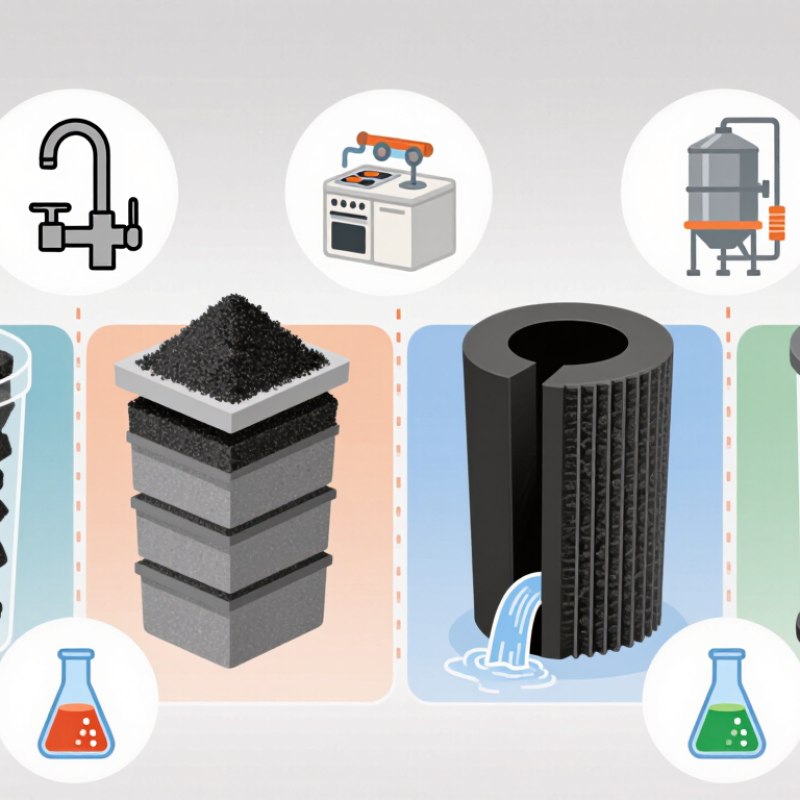
How Carbon Filters Capture and Remove Contaminants
Carbon filters remove contaminants through adsorption, not simple straining. Pollutant molecules cling to the carbon’s porous surface as air or water passes through. Activated carbon’s many tiny pores create a large contact area, but performance depends on the contaminant, carbon quantity, and exposure time. The U.S. EPA Drinking Water Treatability Database gives typical granular activated carbon contact times of about 5–25 minutes. Real systems need testing and careful design.
Granular activated carbon (GAC) is packed into beds or cartridges and is common in water treatment. Powdered activated carbon (PAC) is mixed into water, then removed with the captured material.
In air cleaners, thin carbon sheets can reduce some odors and gases, while thicker beds generally provide more carbon for adsorption. The U.S. EPA’s Residential Air Cleaners: A Technical Summary notes that gas-removal performance depends on the amount and type of sorbent. A carbon filter is not automatically effective against every gas.
Small details matter. A cartridge may look clean while its adsorption sites are already occupied. Flow rate matters, too: water rushing through a bed has less contact time. EPA guidance also distinguishes gas removal from particle filtration; carbon alone does not reliably capture dust. That distinction is easy to miss. Replacement timing should follow measured performance or the maker’s stated service life, not odor alone.
Granular Activated Carbon Filters: Structure and Uses
Granular activated carbon (GAC) filters contain small, porous carbon particles packed inside a cartridge or tank. Their huge internal surface area attracts and holds many dissolved organic compounds. Water moves through the gaps between granules, bringing contaminants into contact with the carbon. That contact time matters. A fast flow can reduce performance, even when the filter looks substantial.
GAC is commonly used to reduce chlorine taste and odor, and some organic chemicals, depending on the filter’s design and certification. It does not reliably remove salts, all metals, or disease-causing microbes. One detail is easy to miss: granules can settle or channel, letting water pass through too quickly. Filter performance also declines as adsorption sites fill, and appearance alone cannot show when that happens.
Tips: Check the filter’s rated uses and replacement schedule. Follow its flow-rate guidance, and replace the cartridge as directed. If water safety is uncertain, use appropriate testing; a carbon filter is not a disinfection method. Small maintenance steps matter.
Granular Activated Carbon (GAC): Common Particle-Size Grades
Typical sieve-size ranges for three commonly used GAC grades. Particle size affects flow and contact time; the appropriate grade depends on the filter design and application.
Ranges are approximate sieve-opening equivalents: 8×30 mesh, 0.60–2.36 mm; 12×40 mesh, 0.425–1.70 mm; 20×50 mesh, 0.300–0.850 mm. Actual specifications vary by media and supplier.
Carbon Block Filters: Design and Filtration Strengths
Carbon block filters are made by compressing fine activated carbon into a dense, porous cylinder. The carbon may come from materials such as coconut shells or coal, depending on the filter design. Water moves through the block rather than around a loose bed, bringing contaminants into contact with its internal surfaces. The structure also acts as a physical barrier. A close-fitting outer shell helps direct water through the carbon, though poor seals can allow bypass.
That design gives carbon blocks two useful filtration actions. Adsorption can reduce chlorine, unpleasant tastes, and odors; the block can also capture some particles, depending on its pore size and rated performance. Finer pores may improve particle reduction, but they can restrict flow. It is a trade-off. A slow stream from a faucet may signal clogging, though low pressure or another system issue can cause the same symptom.
Performance depends on the specific filter, water conditions, and how long water stays in contact with the carbon. A carbon block should not be assumed to remove every dissolved chemical or microorganism. Check independent performance testing for the contaminants of concern, and follow the stated replacement interval. In practice, people often wait too long because the water still looks clear. That is not a reliable test: many substances cannot be seen or tasted.
Impregnated and Catalytic Carbon Filters: Specialized Applications
Impregnated and catalytic carbon filters serve tasks that ordinary activated carbon may not handle well. Impregnated media contains added chemicals that react with specific gases. Depending on its formulation, it can target compounds such as ammonia or acidic gases. The exact target matters: one media type will not capture every contaminant. Check the filter specification against the measured air or water problem.
Catalytic carbon has a modified surface that helps certain reactions happen more readily. It is often used for chloramine in water or hydrogen sulfide in air, depending on system design. Performance still depends on contact time, flow rate, moisture, and competing contaminants. Small changes in these conditions can affect results. In practice, choosing between specialized media is not always tidy, and testing may be needed.
Tips: Identify the contaminant before selecting a filter. Check the operating limits and replacement schedule, then monitor performance after installation. A filter can look clean and still be spent. When results are uncertain, ask a qualified filtration professional to review the application.
Comparing Carbon Filter Types by Performance and Use Case
What Are the Top Types of Carbon Filters?
Granular activated carbon filters use loose carbon particles, giving water or air a large contact surface. They can reduce chlorine taste and some odors, but performance depends on flow rate and contact time. Carbon block filters compress fine carbon into a denser form. They often provide more consistent filtration, though a clogged block can slow water noticeably. Neither type removes every contaminant.
Catalytic carbon is designed to handle certain compounds, such as chloramine, more effectively than standard activated carbon. Impregnated carbon has added materials that target specific substances, so check its stated purpose rather than assuming it is a general upgrade. For a kitchen tap, a certified carbon block may suit taste and odor concerns; a larger system may use granular or catalytic media where flow and contaminant levels justify it. There is no neat winner. I would not choose by media name alone.
Tips: Match the filter to a water test or a clearly identified concern. Check the rated capacity, replacement schedule, and independent certification for the specific contaminant. A filter that is overdue for replacement may perform poorly. Small detail, big difference.