Blog
What Are the Top Grain Silo Manufacturers in China?
Choosing among China’s top grain silo manufacturers requires more than comparing prices, storage volume, or attractive factory photographs. A reliable evaluation must examine engineering experience, steel quality, corrosion protection, ventilation design, temperature monitoring, installation support, and long-term maintenance. These details determine whether stored wheat, corn, rice, or soybeans remain safe during humid summers and sharp seasonal changes. Even a small design weakness can create condensation, hot spots, mold, or difficult grain discharge.
Dr. Dirk Maier, a respected grain-storage specialist and educator, explains the core principle clearly: “A silo is not merely a container; it is part of a complete grain management system.” His observation gives this comparison a practical direction. The strongest Chinese manufacturers usually provide integrated solutions, including silos, conveyors, dryers, aeration fans, sensors, and control systems. Their real value appears during commissioning, not only during a sales presentation. Ask for material certificates, project references, load calculations, warranty terms, and evidence of successful operation. Look closely at roof joints, ladder safety, foundation requirements, and access for cleaning. These features may seem ordinary. They matter greatly.
This guide examines leading Chinese suppliers through an evidence-based lens. It considers manufacturing capacity, customization, export experience, quality control, and after-sales response. The term “grain sild” is sometimes used in online searches, although “grain silo” is the correct industry expression. No ranking is perfect. Buyers should still verify each claim independently, visit operating sites when possible, and match equipment with local grain conditions. That final judgment belongs to the buyer.
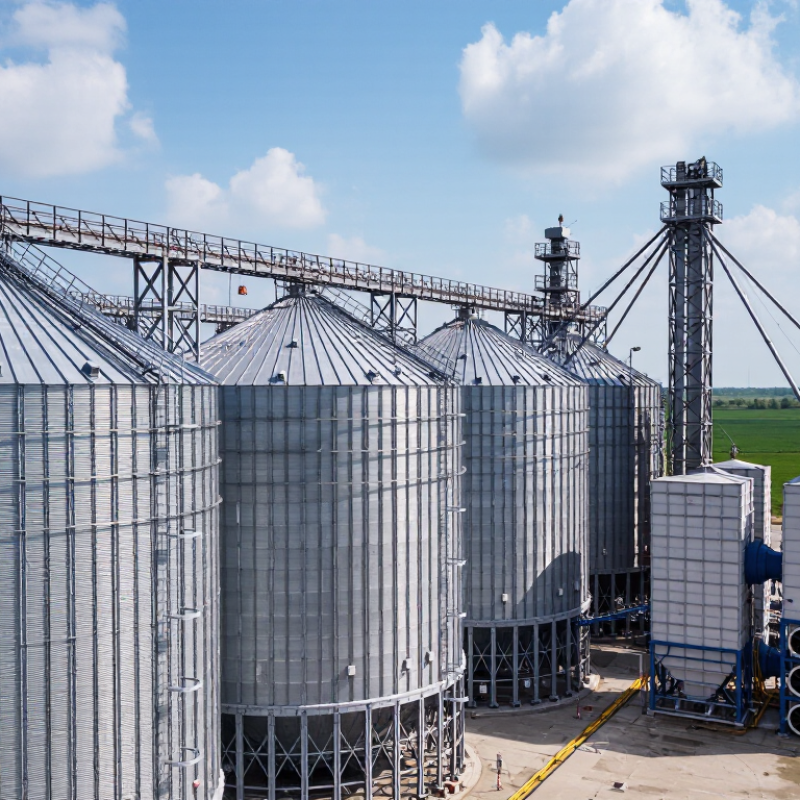
What Is a Grain Silo and Why Does Manufacturer Selection Matter?
A grain silo is an engineered structure for receiving, drying, aerating, and storing cereals. Unlike a simple warehouse, it controls moisture, temperature, airflow, and unloading speed. FAO’s 2024 Food Outlook placed global cereal production near 2.85 billion tonnes, making reliable post-harvest storage increasingly important. China’s National Bureau of Statistics reported 2024 grain output of about 706.5 million tonnes. Even a small design mistake can affect thousands of tonnes.
So, what distinguishes top grain silo manufacturers in China? Look beyond production capacity. Check steel thickness, corrosion protection, aeration layout, temperature sensors, dust-control design, and commissioning records. A qualified manufacturer should provide load calculations, foundation guidance, inspection documents, and clear maintenance procedures. The design must also match the crop. Corn may need stronger aeration than wheat in humid regions. Rice often requires tighter moisture management.
Experience matters on site. Ask whether the supplier has handled similar capacities, climates, and unloading systems. Request measurable evidence, not polished promises. ISO-based quality systems can support consistency, but certification alone cannot prove field performance. That is the uncomfortable part. Buyers sometimes compare only the quoted price, then discover higher energy use or difficult repairs later. A more reliable selection process studies lifecycle cost, spare-part access, response time, and operator training. Industry reports often describe storage as a supply-chain safeguard, yet practical performance depends on installation details. Manufacturers should welcome independent inspection before delivery and after commissioning.
What Are the Top Grain Silo Manufacturers in China? - What Is a Grain Silo and Why Does Manufacturer Selection Matter?
| Evaluation Dimension | Typical Technical Range | Why It Matters | Recommended Verification | Practical Selection Benchmark | Risk if Overlooked |
|---|---|---|---|---|---|
| Storage Capacity | Approximately 100–20,000 metric tonnes per silo, depending on diameter, height, and grain bulk density. | Capacity determines site utilization, foundation loads, conveying requirements, and total project cost. | Request dimensional drawings, usable-volume calculations, and the design bulk density used by the supplier. | Match capacity to turnover plan | Insufficient usable capacity, excessive dead space, or an oversized foundation and handling system. |
| Construction Material | Galvanized or coated carbon steel is commonly used for commercial grain silos; concrete is selected for some high-capacity or permanent installations. | Material affects corrosion resistance, service life, structural performance, and maintenance requirements. | Check steel grade, coating type, coating mass or thickness, fastener material, and corrosion-protection method. | Documented material traceability | Premature corrosion, leakage, structural deterioration, or higher lifecycle cost. |
| Structural Design | Design should account for stored-grain pressure, wind, seismic loads, roof loads, discharge loads, and local code requirements. | Loads vary significantly between filling, storage, aeration, and unloading conditions. | Ask for signed calculations, load cases, connection details, and foundation reaction data. | Project-specific engineering | Buckling, excessive deformation, connection failure, or unsafe operation. |
| Grain Compatibility | Common applications include wheat, corn, rice, barley, soybeans, rapeseed, and other free-flowing dry grains. | Different grains have different moisture, flow, abrasion, and aeration characteristics. | Provide the grain type, bulk density, moisture range, temperature range, and expected storage duration. | Designed for the actual commodity | Bridging, rat-holing, segregation, spoilage, or difficult discharge. |
| Temperature Monitoring | Multi-point cable or sensor systems are commonly installed to detect temperature changes within stored grain. | Localized heating can indicate insect activity, moisture migration, or biological deterioration. | Verify sensor spacing, measuring zones, data logging, alarms, and access for maintenance. | Continuous monitoring with alarms | Delayed detection of hot spots, quality loss, mold growth, or fire risk. |
| Aeration System | Fans and ducts are selected according to grain type, silo diameter, climate, moisture content, and target cooling rate. | Correct airflow helps control grain temperature and moisture migration during storage. | Request airflow calculations, fan curves, duct layout, static-pressure data, and operating procedures. | Engineered airflow, not a standard package | Uneven cooling, condensation, excessive energy use, or grain spoilage. |
| Discharge Configuration | Flat-bottom silos generally use sweep augers or reclaim systems; hopper-bottom silos support gravity-assisted discharge. | The outlet design affects residue level, unloading time, labor, and suitability for frequent turnover. | Check outlet size, hopper angle, sweep equipment, cleanout access, and expected residual grain percentage. | Select by turnover frequency | Product buildup, cross-contamination, slow unloading, or increased cleaning costs. |
| Dust and Explosion Safety | Grain handling areas require dust-control measures, suitable electrical equipment, grounding, bonding, and safe operating procedures. | Grain dust can create combustible atmospheres when dispersed and ignited. | Review dust collection, venting, grounding, ignition-source control, housekeeping, and applicable local regulations. | Safety engineered from the start | Fire, dust explosion, equipment damage, injury, or regulatory non-compliance. |
| Manufacturing Quality Control | Important controls include dimensional inspection, coating inspection, bolt-torque control, weld inspection where applicable, and batch traceability. | Consistent fabrication quality directly affects field assembly, sealing, and structural reliability. | Request inspection plans, coating reports, material certificates, nonconformance procedures, and sample records. | Auditable quality documentation | Assembly delays, water ingress, uneven loading, and early component failure. |
| Installation Support | Support may include foundation drawings, installation manuals, supervisor services, commissioning, and operator training. | Correct assembly is essential for silo alignment, sealing, structural integrity, and equipment performance. | Confirm installation scope, site responsibilities, training hours, spare parts, and commissioning procedures. | Clear responsibility matrix | Rework, schedule overruns, unsafe assembly, or disputes over project responsibility. |
| Standards and Compliance | Projects may need to comply with applicable national building, electrical, fire-safety, occupational-safety, and grain-storage regulations. | Compliance requirements vary by destination country, climate, seismic zone, and end-user industry. | Identify the governing codes before design approval and request compliance statements and engineering records. | Destination-market compliance | Permit rejection, redesign, shipment delays, insurance problems, or legal exposure. |
| After-Sales Service | Relevant services include spare-parts supply, troubleshooting, inspection, sensor replacement, and technical response. | A silo is a long-life asset; service availability affects uptime and grain quality over many years. | Review warranty terms, response times, spare-parts lead times, remote support, and maintenance schedules. | Lifecycle support in writing | Extended downtime, unavailable parts, higher maintenance cost, or abandoned equipment. |
| Total Cost of Ownership | Assessment should include equipment, civil works, transport, installation, energy, maintenance, cleaning, and replacement parts. | The lowest purchase price may not provide the lowest long-term operating cost. | Compare complete quotations using the same capacity, performance, safety, and service assumptions. | Evaluate lifecycle cost, not only purchase price | Unexpected capital expenses, high energy consumption, frequent repairs, or poor return on investment. |
Note: The figures and benchmarks above represent commonly used industry evaluation ranges and practices. Final silo dimensions, materials, airflow, structural loads, safety systems, and applicable standards must be confirmed through project-specific engineering and local regulatory review.