How to Choose the Best Pool Cleaning Accessories
Choosing the right pool tools can make weekly maintenance faster, safer, and less frustrating. Pool Cleaning Accessories range from leaf nets and brushes to vacuum heads, hoses, and water-testing kits. Each solves a different problem. A deep leaf net lifts floating debris, while a brush with softer bristles can help protect delicate pool finishes. For fine dust on the floor, a suitable vacuum attachment may do more than repeated brushing.
Small details matter. Check the pole connection, hose diameter, and the size of the pool before buying. A tool that looks sturdy in a product photo may feel awkward when reaching across a wide pool. I would not pretend one kit suits every pool. Surface type, nearby trees, and how often the pool is used all change what is useful.
The best choice depends on your maintenance routine and the equipment you already own. A small above-ground pool may need only a compact net, a compatible brush, and basic testing supplies. A larger pool with heavy leaf fall may call for a wider net and a vacuum system designed for its setup. Compatibility matters. Follow the pool and accessory manufacturers’ instructions, especially when selecting brushes or connecting equipment. This guide will help you compare practical features, avoid buying tools you will rarely use, and choose accessories that fit your pool. Still, no accessory replaces regular checks. That is worth remembering.
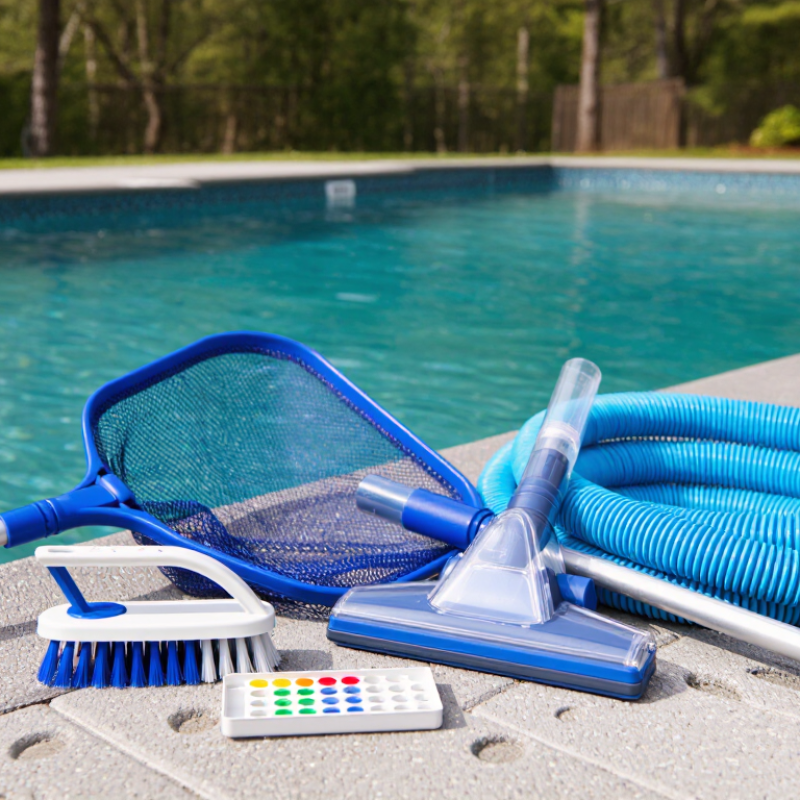
Identify Pool Surface, Size, and Debris Before Choosing Accessories
A pool’s surface should guide the brush and vacuum head you choose. Surface matters. Plaster can usually tolerate firmer brushing, while vinyl liners need softer bristles to reduce the chance of scuffs or damage. For tile, a brush suited to grout lines can loosen buildup without forcing debris deeper into the joints. Check the pool’s care instructions before buying, since surface materials and finishes vary.
Pool size affects reach and effort. A short telescopic pole may work well in a compact above-ground pool, but a larger pool often calls for a longer pole and a hose that can reach the far wall without pulling tight. Measure the deepest area and the distance from the waterline to the equipment connection. Check the fit. Small mismatches can make cleaning awkward, even when an accessory looks suitable online.
Look closely at what collects in the water. Large leaves call for a sturdy skimmer net with a roomy mesh bag; fine dust or sand may need a vacuum head designed to capture smaller particles. Wind-blown seeds can clog some nets quickly. That detail is easy to miss. If you are unsure about compatibility, compare the accessory’s specifications with your pool equipment and test it gently in a small area.
Match Skimmers and Brushes to Debris Types and Pool Surfaces
Choose a skimmer by the debris you actually find, not just by its handle. A wide, open mesh gathers leaves, twigs, and seed pods quickly. Fine mesh catches pollen and small grit, but it can clog fast. Fine nets clog quickly. If you skim after windy weather, empty the net often so it stays easy to move.
Brush bristles should suit the pool surface. Nylon bristles are generally a gentler choice for vinyl and fiberglass. For plaster or concrete, a stiffer brush may loosen algae and dirt from textured areas. Some brushes combine nylon and stainless-steel bristles, but metal can damage softer finishes. Check the pool surface guidance before using one. A softer touch helps. Pay attention to corners, steps, and the waterline, where grime tends to linger.
Match the brush width to the area: a broad head covers open walls, while a smaller brush reaches around ladders and tight curves. There is no perfect pairing for every pool; even the right tool can miss a patch if the angle is awkward. After brushing, skim loosened debris before it settles. If a net repeatedly catches on the liner or a brush leaves marks, stop and reassess the tool rather than pressing harder.
Select Test Kits for CDC Targets: pH 7.0–7.8 and Free Chlorine ≥1 ppm
A useful pool-testing kit should measure pH and free chlorine clearly. For routine pool checks, CDC guidance gives a pH range of 7.0–7.8 and at least 1 ppm free chlorine. Look for a kit with readable color comparisons and instructions that specify sample volume and timing. Small details matter.
Liquid reagent kits can offer distinct color changes, while strips are quick and convenient. Choose the format you can use consistently. Check the expiration date, store reagents as directed, and replace faded color charts. A test result is only as dependable as the kit and the person reading it.
Collect water away from return jets and skimmers, following the kit’s directions. Rinse the sample container with pool water first, then avoid touching its inside. Test in good light; compare colors promptly, since waiting can alter the reading. Record pH and free chlorine, not just total chlorine. If a value falls outside the target, retest before adjusting the water. Even careful testing can feel less exact than the numbers suggest. Check again after circulation, and never guess from water clarity alone.
Check Pole, Hose, and Electrical Compatibility Before Buying
How to Choose the Best Pool Cleaning Accessories
Check Pole, Hose, and Electrical Compatibility Before Buying
A cleaning accessory can look right and still fail to fit. Check your pole’s diameter and connection type, including whether it uses a threaded end or a clip. Measure before ordering. Small details matter. For hoses, compare the cuff shape, diameter, and length with your cleaner’s requirements. A hose that is too short may restrict movement; one that is too long can kink around steps or corners. I’ve seen compatibility overlooked when shoppers focus only on price. It is an easy mistake to make.
Electrical compatibility matters for powered cleaners and accessories. Match the required voltage, plug type, and power supply listed in the equipment manual. Do not assume that a similar-looking connector is suitable. Check for damaged cords or loose connections, and disconnect power before inspecting electrical parts. If the specifications are unclear, ask a qualified pool technician rather than guessing. A small mismatch can cause poor performance or create a safety risk.
Tips: Keep your cleaner’s model details and measurements handy while shopping. Photograph the pole fitting and hose cuff for comparison. Measure twice. Check the manual again, too; product descriptions can be incomplete, and compatibility is not always obvious.
How to Choose Pool Cleaning Accessories
Common pool vacuum hose sizes are 1.25 and 1.5 inches in nominal diameter. Confirm the hose size and end connectors match your equipment. Before buying, also check that the pole connector fits and that any electrical equipment matches the required voltage and local electrical requirements.