Blog
How to Choose Contact Ball Bearings in 2026?
Choosing a Contact Ball Bearing is not a catalog exercise. It is an engineering decision shaped by load direction, speed, temperature, lubrication, mounting accuracy, and the cost of failure. A bearing that fits the shaft can still run hot, vibrate, or wear early when its real operating conditions are overlooked. Small details matter: a dusty seal, a thin grease film, or a housing that is slightly misaligned.
Market reports show why this component deserves careful attention. Grand View Research estimated the global ball bearing market at USD 20.7 billion in 2023 and projected an 8.2% compound annual growth rate from 2024 to 2030. That figure covers ball bearings broadly, not contact ball bearings alone, so it is context—not a selection rule. Bearing engineer and author John M. Beswick’s design work points to a practical principle: choose for the application’s actual conditions, not simply a catalog headline. This is a paraphrase, not a verified verbatim quotation.
Start with the loads and operating speed. Then check required life, available space, lubrication method, sealing, noise limits, and maintenance access. Contact angle affects how a bearing carries combined radial and axial loads; preload and fit can change stiffness, heat, and service life. There is no universal best choice. Real installations can also differ from clean test conditions, and that uncertainty deserves review. The sections ahead explain how to compare bearing types, read specifications, assess materials and seals, and confirm a selection before purchase.
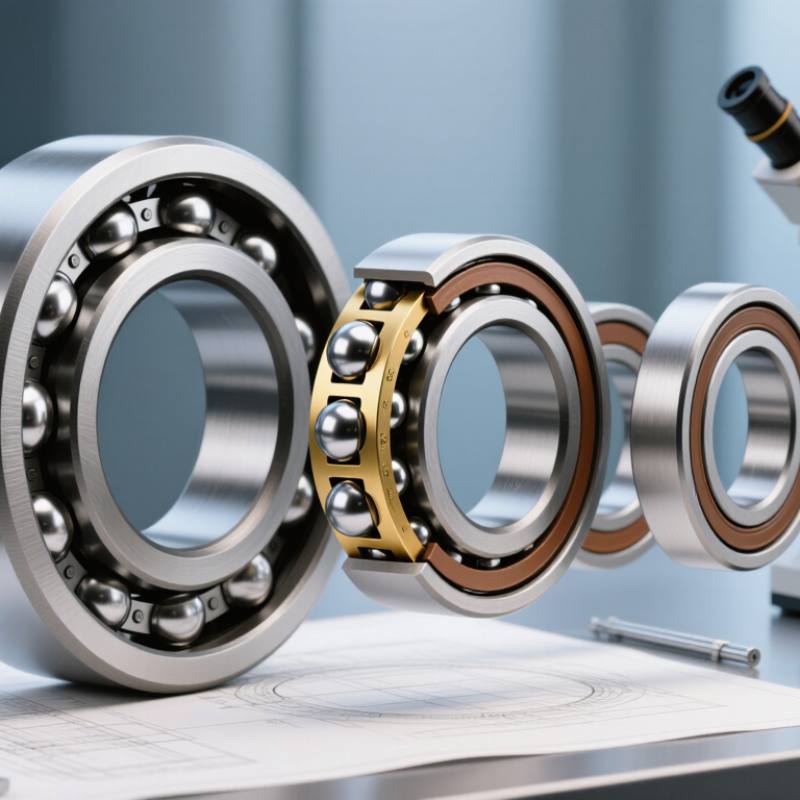
Identify the Contact Ball Bearing Type and Contact Angle
How to Choose Contact Ball Bearings in 2026?
Identify the Contact Ball Bearing Type and Contact Angle
Start with the load direction. Deep-groove ball bearings mainly support radial loads, though they can handle some axial load. Angular-contact bearings carry combined radial and axial loads, with capacity depending on their design and arrangement. A single angular-contact bearing typically supports axial load in one direction. Paired bearings can support loads in both directions. Four-point-contact designs suit certain applications with axial loads from either direction, but they are not a universal substitute.
The contact angle is the angle between the bearing’s contact line and a plane perpendicular to its axis. A larger angle generally increases axial-load capacity, while a smaller angle favors radial-load applications. That trade-off matters. Check the expected load, speed, stiffness, and available space before choosing. Also confirm whether the bearing will be mounted alone or paired; the arrangement changes how it carries load. Catalog angle values and limits vary, so verify the specification for the exact bearing.
Tips: Check the machine drawing and load direction, then compare the bearing’s rated speed and clearance with operating conditions. Ask whether misalignment, heat, or preload could change performance. Don’t choose by contact angle alone. It is easy to overlook mounting details, and that is worth a second look.
How to Choose Contact Ball Bearings in 2026? - Identify the Contact Ball Bearing Type and Contact Angle
| Bearing Type | Typical Contact Angle | Load Capability | Typical Applications | Selection Considerations |
|---|---|---|---|---|
| Deep-Groove Ball Bearing | Approximately 0° in the unloaded state; the angle can increase under axial load | Primarily radial loads; can also carry limited axial loads in both directions | Electric motors, pumps, fans, household equipment, and general machinery | A versatile option for high-speed operation and relatively simple arrangements. Check axial load, clearance, and operating conditions. |
| Single-Row Angular-Contact Ball Bearing | Common design angles include 15°, 25°, 30°, and 40° | Combined radial and axial loads; axial load is supported in one direction per bearing | Machine-tool spindles, pumps, compressors, and gearboxes | A larger contact angle generally increases axial-load capacity but may reduce high-speed capability. A second bearing is often used for loads in both axial directions. |
| Double-Row Angular-Contact Ball Bearing | Often approximately 25° to 30°, depending on design | Combined radial and axial loads in both directions | Wheel-support units, pumps, and machinery with limited axial space | Can provide a compact arrangement that supports axial loads in both directions. Confirm load, rigidity, and mounting requirements for the specific design. |
| Four-Point-Contact Ball Bearing | Commonly approximately 35° or 45°, depending on design | Axial loads in both directions and limited radial load | Machine-tool supports, slewing arrangements, and applications requiring a compact axial-load solution | Often used where a single bearing must support bidirectional axial loads. Radial load capacity and operating speed depend on the bearing design and loading conditions. |
| Thrust Ball Bearing | Approximately 90° to the bearing axis for axial load support | Axial loads; not intended to support significant radial loads | Vertical shafts, turntables, and low-speed axial-load positions | Choose a suitable single-direction or double-direction arrangement. Check speed limits, lubrication, and shaft alignment. |
Note: Contact-angle values are typical design values, not universal specifications. Actual angles, load ratings, speed limits, and permissible operating conditions vary by bearing series and design; verify them against the relevant technical catalog.