China Best Waste Crusher Manufacturer for Global Buyers?
China Best Waste Crusher Manufacturer for Global Buyers?
Waste volumes are rising, but buying a crusher is not simply a matter of choosing the largest machine. The United Nations Environment Programme’s Global Waste Management Outlook 2024 estimates that municipal solid waste reached 2.1 billion tonnes in 2023. Without stronger action, it could reach 3.8 billion tonnes by 2050. These figures underline the need for practical processing systems, including reliable Waste Crusher equipment that can reduce material size and support recovery.
Ellen MacArthur, a leading circular-economy advocate, summarizes the broader goal: “A circular economy is based on the principles of designing out waste and pollution, keeping products and materials in use, and regenerating natural systems.” A crusher can support that goal, but it cannot achieve it alone. Buyers should compare feed materials, required output size, throughput, energy use, wear parts, and access to technical service. A machine suited to concrete rubble may not perform well with mixed or wet material. A real test.
China offers a wide range of manufacturers, from established exporters to smaller factories with narrower product lines. The “best” supplier depends on the buyer’s material, operating conditions, budget, and support needs. Ask for test results using comparable feedstock, clear specifications, and verifiable customer references. Still, specifications do not reveal every maintenance issue, and supplier claims deserve careful checking. This guide examines what global buyers should assess before selecting a Chinese Waste Crusher manufacturer.
What Is a Waste Crusher and How Does It Work?
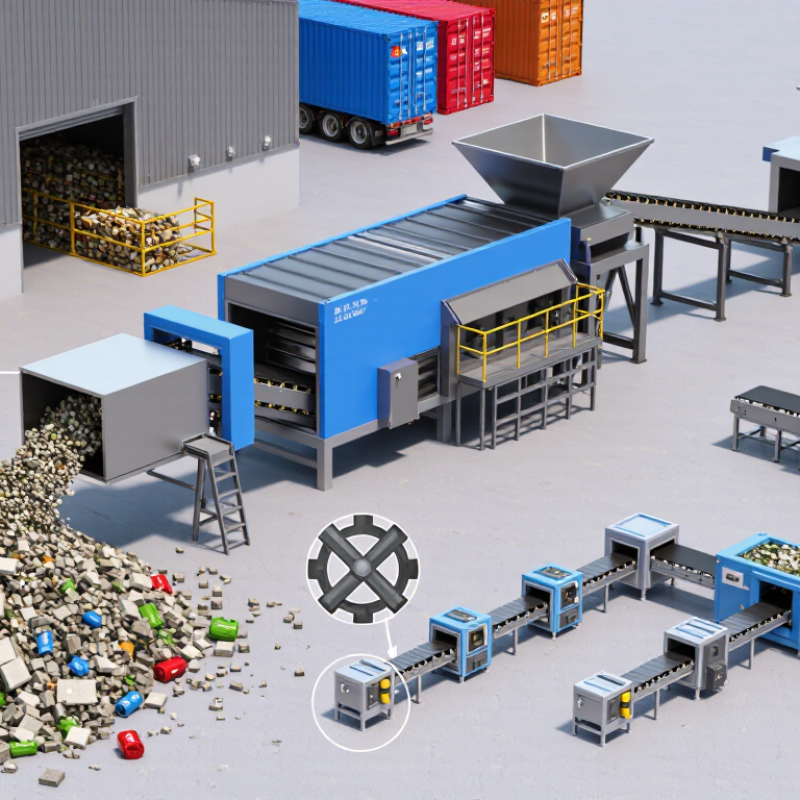
A waste crusher reduces bulky discarded material into smaller, more manageable pieces. It can process items such as packaging, wood offcuts, or mixed production waste, depending on its design. Inside, rotating shafts fitted with cutters pull material inward and tear or shear it apart. Other machines use hammers or impact force. The working principle is simple, but the result depends on the material, cutter shape, and machine settings.
Some crushers use a screen to control the size of the output. If a piece is still too large, it may stay in the chamber for another pass. Small, steady bites. A crusher does not sort waste or make it recyclable by itself. Sorting and further processing may still be needed.
Before feeding material, operators should check for items the machine is not designed to handle. A sudden metal object can damage cutters or trigger a shutdown. Wet film and tangled textiles may wrap around moving parts, so feed rate matters. Regular checks of cutters, bearings, and safety guards help keep operation predictable. Real waste is rarely uniform. That detail is easy to underestimate when selecting a machine: a crusher suited to clean, dry offcuts may struggle with damp, mixed loads.
Types of Waste Crushers and Their Industrial Applications
Waste crushers serve different jobs, and choosing by capacity alone can lead to poor results. Twin-shaft crushers use slow, high-torque cutters to break bulky waste such as discarded furniture, pallets, and mixed packaging. Their steady action suits transfer stations and pre-processing lines.
Single-shaft machines use a rotor and screen to produce more consistent particle sizes, making them useful for plastics, wood, and production scrap. Output still depends on the screen opening and the material’s condition.
Hammer mills use fast-moving hammers to reduce brittle materials, including certain wood residues and mineral-based waste. They can create fine output, but wet or fibrous feed may clog the machine. Jaw crushers are better suited to hard, bulky construction debris, such as concrete and masonry, before further sorting or processing.
Not every site needs the finest size. In practice, contamination, moisture, and changing feed composition can matter as much as throughput. That detail is easy to overlook.
Operators should check wear parts, screen condition, and motor load during routine inspections. A crusher may look suitable on paper, yet struggle with real-world waste. Testing representative material helps reveal that gap.
How to Evaluate a Waste Crusher Manufacturer in China
China Best Waste Crusher Manufacturer for Global Buyers?
How to Evaluate a Waste Crusher Manufacturer in China
Choosing a waste crusher manufacturer takes more than comparing quoted prices. The World Bank’s What a Waste 2.0 report estimates that the world generated 2.01 billion tonnes of municipal solid waste in 2016, with annual volume projected to reach 3.40 billion tonnes by 2050. These figures show the scale of the challenge, but they do not prove that one machine suits every site. Ask manufacturers to define the feed material, moisture range, target particle size, and rated throughput behind each performance claim. Get the assumptions in writing.
Request a witnessed trial using material similar to your own. Record output per hour, energy use per tonne, particle consistency, noise, and downtime. A clean demonstration feed may not reflect mixed, bulky waste. Ask for wear-part specifications, replacement intervals, maintenance access, and a clear list of exclusions. Check whether the supplier can provide drawings, operating manuals, spare-part lead times, and remote or on-site technical support. Compare like with like. A low purchase price can become costly if the rotor, screens, or service plan do not match your operating conditions. I would still treat any promised output as provisional until the test conditions are verified.
Tips: Request a written test report, not just a video. Confirm what the warranty covers, and ask for references from facilities processing similar material. Small detail, big difference.
Key Specifications for Global Buyers to Compare
Global buyers comparing waste crushers should look beyond advertised tonnes per hour. The World Bank’s What a Waste 2.0 report estimated that cities generated 2.01 billion tonnes of municipal solid waste in 2016, with the figure projected to reach 3.40 billion tonnes by 2050. That scale makes reliable processing capacity important. Still, a large capacity claim means little without details about feed material and operating conditions.
Compare feed-opening dimensions, motor power, rotor speed, and target output size. Ask whether figures assume dry, uniform material; wet or mixed feed can change throughput. Check energy use per tonne, replaceable wear parts, maintenance access, and the time needed to clear jams. A wider opening may accept bulkier items, but it does not guarantee finer, consistent output. Request test results using material similar to your own, including moisture content and particle-size measurements.
Tips: Ask suppliers for a written test protocol and operating data, not just a headline capacity. Confirm that the quoted output size matches your next processing step. Inspect access to blades and screens, and clarify spare-part lead times. Small details matter. I would also compare noise and dust-control provisions; these are easy to overlook when reviewing a specification sheet.
International Sourcing, Compliance, and After-Sales Support
Global sourcing of a waste crusher should begin with the material, not the catalogue. Ask suppliers to confirm throughput using your actual feedstock, including moisture, particle size, and contamination. A short sample run can reveal jams or uneven output that a specification sheet may hide. Details matter. UNEP’s Global Waste Management Outlook 2024 estimates that municipal solid waste could rise from 2.1 billion tonnes in 2023 to 3.8 billion tonnes by 2050. That pressure makes dependable equipment and clear operating limits important, but higher capacity alone is not proof of a good fit.
Before ordering, check that manuals, electrical details, guarding information, and test records match the requirements of the destination market. Requirements differ by country, so have local compliance professionals review the documents. Agree on acceptance tests, spare-parts lists, warranty scope, and response times in writing. Ask how remote troubleshooting works when a control fault stops production on a Friday. After-sales support is practical, not decorative. The World Bank’s What a Waste 2.0 report also highlights major differences in waste systems across regions; a solution suited to one site may perform poorly elsewhere. One checklist can still miss things. Revisit it with operators who will maintain the crusher every day.