Blog
China Top Hot Dip Galvanized Steel Coil Supplier
Choosing a China Top Hot Dip Galvanized Steel Coil Supplier requires more than comparing prices. Buyers need evidence, process knowledge, and dependable communication. A reliable supplier should explain coating mass, steel grade, coil width, surface finish, and delivery conditions clearly.
Dr. Frank Goodwin, a recognized zinc and galvanizing specialist, has stated, “Zinc protects steel because it sacrifices itself first.” This principle explains the value of Hot Dip Galvanized Steel Coil. During production, cleaned steel passes through molten zinc. The coating bonds metallurgically with the surface. It then protects the substrate through barrier and sacrificial action.
Small details matter.
A professional Chinese supplier should provide mill test certificates, coating inspection records, and traceable production numbers. Buyers may also request samples with visible edges, consistent spangles, and smooth recoiling. In coastal projects, coating weight and drainage design deserve careful attention. In automotive or construction applications, formability and surface appearance may carry different priorities.
Experience still exposes imperfections. Even a capable factory can face surface marks, coil telescoping, or delayed documentation. Honest suppliers explain these risks before shipment. They also describe corrective actions without hiding inconvenient facts. That approach builds credibility.
A strong sourcing decision should consider production equipment, inspection capacity, export experience, and after-sales support. It should not depend on attractive photographs alone. The best Hot Dip Galvanized Steel Coil partner combines technical evidence with practical responsiveness. China offers many capable manufacturers, but quality varies. Careful verification remains essential.
Definition and Role of Hot Dip Galvanized Steel Coils
China Top Hot Dip Galvanized Steel Coil Supplier
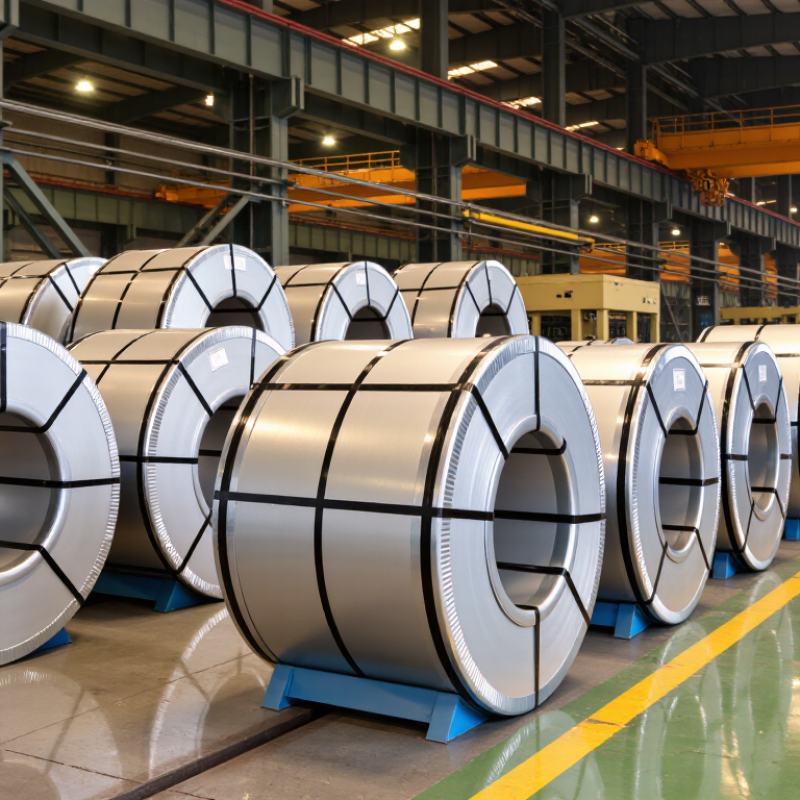
Hot dip galvanized steel coil is flat steel coated with zinc through a continuous molten-zinc bath. The strip usually enters the bath near 450°C, then passes through air knives that control coating thickness. Zinc protects steel in two ways: it creates a barrier and sacrifices itself when exposed. This makes galvanized coil useful for roofing panels, ducts, vehicle parts, appliances, and structural components.
The role of galvanized coil is practical, not decorative. It extends service life in humid, industrial, and outdoor environments. World Steel Association data reports approximately 1.89 billion tonnes of crude steel production in 2023. Even a small galvanized share represents a major demand for corrosion-resistant material. Industry standards such as ISO 1461 and EN 10346 help define coating quality, surface condition, and mechanical performance. However, continuous galvanized coil requires specifications suited to forming and painting.
More zinc is not always better. Excessive coating weight can affect welding, bending, and surface appearance. Edge cracking, uneven coating, or poor storage can also reduce real-world durability. Experience shows that packaging matters; trapped moisture between tightly stacked coils may create white rust. The International Zinc Association identifies galvanizing as a major zinc-use sector, supporting its importance in infrastructure protection. Still, coating selection should consider exposure, forming depth, steel grade, and expected maintenance. A supplier’s certificate is useful, but independent testing remains wiser.
China Top Hot Dip Galvanized Steel Coil Supplier - Definition and Role of Hot Dip Galvanized Steel Coils
| Category | Data Dimension | Typical Value or Reference | Role and Practical Meaning |
|---|---|---|---|
| Definition | Product form | Flat-rolled carbon steel strip coated with zinc in a continuous hot-dip process and supplied in coil form | Provides a corrosion-resistant material that can be slit, cut, stamped, roll-formed, or fabricated. |
| Manufacturing | Main process sequence | Cleaning, pickling or chemical preparation, annealing, immersion in molten zinc, wiping, cooling, and recoiling | Removes surface contamination and forms a metallurgically bonded zinc coating on the steel substrate. |
| Zinc Bath | Operating temperature | Usually around 450°C; pure zinc melts at approximately 419.5°C | The heated bath allows zinc to wet the steel and develop iron-zinc alloy layers beneath the outer zinc layer. |
| Coating Mass | Common coating designations | Approximately Z100 to Z600 g/m² total for both sides, depending on the applicable specification | Higher coating mass generally provides greater zinc reserve, but the required level depends on exposure, forming, welding, and cost requirements. |
| Coating Thickness | Approximate equivalent thickness | A total coating mass of 100 g/m² is approximately equivalent to 7 µm of zinc when averaged across both surfaces | Coating mass and coating thickness are related but are not interchangeable without considering zinc density and measurement location. |
| Steel Thickness | Typical commercial range | Approximately 0.25–3.00 mm, subject to production capability and specification | Thin gauges support lightweight panels and formed parts; thicker gauges provide higher stiffness and load-carrying capacity. |
| Coil Width | Typical commercial range | Approximately 600–1,850 mm, depending on the ordered product and processing line | Width selection should match the required blank size, forming equipment, slitting plan, and material utilization target. |
| Steel Grade | Common grade groups | Commercial quality, forming quality, structural quality, and higher-strength low-alloy grades | Grade selection controls formability, yield strength, tensile strength, weldability, and suitability for structural applications. |
| Mechanical Performance | Key indicators | Yield strength, tensile strength, elongation, bend performance, and surface quality | These values determine whether the coil is suitable for deep drawing, roll forming, stamping, or load-bearing components. |
| Corrosion Protection | Protection mechanisms | Barrier protection, sacrificial protection, and formation of protective zinc corrosion products | Zinc protects exposed steel preferentially and helps slow corrosion at small scratches or cut edges under suitable conditions. |
| Surface Finish | Available surface conditions | Regular spangle, minimized spangle, skin-passed, and surface-treated options | Surface selection affects appearance, paint adhesion, roughness, forming behavior, and resistance to storage-related staining. |
| Dimensional Control | Quality parameters | Thickness tolerance, width tolerance, flatness, camber, coil inside diameter, and coil mass | Consistent dimensions reduce production interruptions and improve yield during automated processing. |
| Applicable Standards | Common references | ASTM A653/A653M, EN 10346, JIS G3302, and other regional specifications | The selected standard defines chemical composition, mechanical properties, coating mass, dimensions, testing, and acceptance criteria. |
| Fabrication | Processing compatibility | Suitable for slitting, leveling, roll forming, bending, stamping, and controlled welding | Processing parameters should account for coating mass, zinc vapor generation during welding, tooling wear, and bend radius. |
| Typical Applications | End-use sectors | Roofing and wall panels, HVAC ducts, structural framing, automotive components, appliances, cable trays, and general fabrication | The combination of steel strength, zinc protection, and coil-based processing supports high-volume manufacturing. |
| Storage | Recommended conditions | Store indoors in a dry, ventilated area; avoid direct contact with water, condensation, and corrosive chemicals | Proper storage helps prevent wet storage stain, white rust, edge corrosion, and surface damage before fabrication. |
| Selection Priorities | Main purchasing factors | Steel grade, thickness, width, coating mass, surface condition, standard, coil weight, and required delivery form | Matching the specification to the service environment and fabrication method improves durability, process efficiency, and total cost control. |