Blog

What Is a BMS Active Balancer and How Does It Work?

A battery pack can look healthy at its terminals while individual cells quietly drift apart. That gap matters. The International Energy Agency reported nearly 14 million electric-car sales worldwide in 2023, about 18% of all car sales. More batteries mean greater attention to pack performance, cell variation, and service life. BloombergNEF’s 2024 Battery Price Survey also placed the average lithium-ion pack price at $115 per kilowatt-hour. Those figures describe a fast-growing, cost-conscious industry, but they do not prove that any single balancing method is best.

A Bms Active Balancer transfers energy from higher-charge cells to lower-charge cells instead of simply burning excess energy as heat. Depending on its design, it may use capacitors, inductors, or transformer-based circuits. The practical detail is small but important: a circuit board must measure cell voltages, then move energy without exceeding the pack’s limits. Battery-management researcher Gregory L. Plett’s published work supports a useful principle: each cell must be monitored, not just the pack’s total voltage. This is a paraphrase, not a verbatim quotation. Active balancing can improve usable capacity in an imbalanced pack, but results depend on chemistry, current, temperature, and control quality. It is not a cure-all. A weak cell may still need diagnosis or replacement. This guide explains how the circuits work, what their measurements mean, and where their benefits—and limitations—show up in real battery systems.
What Is a BMS Active Balancer and How Does It Work?

What an Active Balancer Is in a Battery Management System

An active balancer is a circuit within a battery management system that redistributes energy among cells. Unlike passive balancing, which turns excess energy into heat, it moves energy from higher-voltage cells to lower-voltage ones. Some designs transfer energy directly between cells; others route it through the battery pack. Small differences matter.

The BMS monitors each cell’s voltage and may also consider temperature and operating conditions. When one cell rises above a chosen threshold, the balancer can shift some of its energy elsewhere. The goal is to keep cells closer in charge, so the pack can use more of its available capacity. This transfer takes time and depends on the circuit’s design.

Active balancing is not a repair tool. It cannot restore a cell that has lost capacity or correct a faulty connection. A weak cell may still limit the whole pack, even when voltages look similar at rest. That distinction matters. When assessing a system, look for clear balancing thresholds and cell-level voltage readings. A voltage gap that shrinks during charging is useful evidence, but it does not tell the whole story. Temperature, load, and cell condition can change the result.

Key Components That Enable Active Cell Balancing

What Is a BMS Active Balancer and How Does It Work?

Key Components That Enable Active Cell Balancing

An active balancer relies on several parts working together. Voltage-sensing circuits measure each cell, while a controller compares readings and decides when energy should move. Switching devices, often MOSFETs, direct that energy through capacitors, inductors, or a transformer. The exact path depends on the balancer’s design. Instead of wasting excess energy as heat, the circuit can transfer it from a higher-energy cell to a lower-energy one. Small details matter.

Temperature sensors and protective logic help keep balancing within safe operating limits. The controller may pause transfer if temperatures rise or readings fall outside configured limits. Accurate measurements matter, but voltage alone does not reveal a cell’s full state of charge; chemistry, temperature, and recent load can affect readings. A well-designed system accounts for those limits. It is easy to overlook wiring resistance, too, which can distort measurements and complicate troubleshooting.

Tips: Check cell-voltage readings and temperature trends under consistent conditions. Confirm that connectors are secure, and follow the battery maker’s balancing specifications. If readings behave unexpectedly, pause and investigate rather than assuming the balancer has corrected the underlying issue. Active balancing can redistribute energy, but it cannot repair a damaged cell.

How the Balancer Detects Voltage Differences Between Cells

An active balancer begins with cell-voltage measurements. Thin sense wires connect each cell group to the BMS monitoring circuit, which samples voltages and converts them into digital readings. The controller compares the highest and lowest readings, rather than relying only on pack voltage. Small differences matter.

When the gap crosses a configured limit, the BMS checks whether it persists. This delay helps avoid reacting to brief changes caused by acceleration or charging current. If balancing is needed, the active circuit moves energy from higher-voltage cells toward lower-voltage ones. The trigger value is not universal; cell chemistry, temperature, and operating conditions all matter. A voltage gap is useful evidence, but not a perfect measure of charge.

The scale of the industry makes dependable monitoring important: the International Energy Agency’s Global EV Outlook 2024 reports that battery demand for energy applications exceeded 750 GWh in 2023. That figure does not define a balancing threshold, but it shows how many cells must work together. In practice, a voltage reading can shift under load and settle afterward, so timing matters. Engineers should review sensor accuracy and behavior across charging, rest, and discharge—not just one bench test. A BMS can still miss subtle imbalance if its measurements are noisy or poorly calibrated.

How Energy Is Transferred from Higher-Charge to Lower-Charge Cells

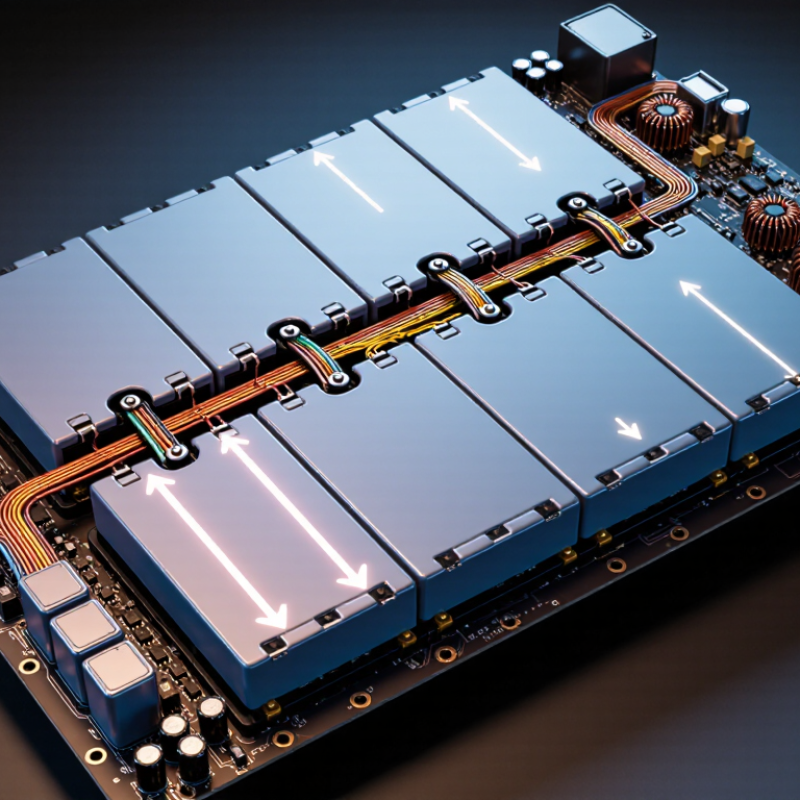
An active balancer moves energy between cells instead of burning excess charge as heat. When one cell reaches a higher charge level, the BMS detects the mismatch and controls a converter. The converter may use inductors, capacitors, or a transformer to move energy toward a lower-charge cell. Think of a small current leaving one cell and returning through the circuit to another. The transfer happens in measured pulses, not as a direct connection between cell terminals.

The BMS monitors cell voltage, current, and temperature, then adjusts the transfer to stay within operating limits. Voltage is only a clue: it can shift with load and temperature, so a voltage difference does not always mean the same difference in stored energy. Details matter. Conversion also wastes some energy as heat, so the receiving cell gets less than the sending cell gives up. NREL’s 2024 Annual Technology Baseline uses about 85% round-trip efficiency for utility-scale lithium-ion storage. That figure describes the whole storage system, not an active balancer alone.

In a real pack, balancing may take time, especially when cells differ substantially or charging current is high. The BMS may pause transfer when temperatures rise or measurements look uncertain. This is less tidy than a simple “full cell to empty cell” picture. An active balancer can reduce uneven charge, but it cannot repair a worn or damaged cell. It can also move only the energy its circuit and control limits allow.

What Is a BMS Active Balancer and How Does It Work? — How Energy Is Transferred from Higher-Charge to Lower-Charge Cells

Topic How It Works Practical Details
Purpose An active balancer helps reduce differences in charge among cells connected in series. Balancing can help keep cells within their permitted voltage limits and make more of the pack’s capacity usable.
Energy transfer Rather than dissipating most of the excess energy as heat, an active circuit moves energy from a higher-charge cell or cell group toward a lower-charge one. The energy is transferred through power-conversion components; it does not travel directly between cells without a circuit.
Common circuit methods Depending on the design, switching capacitors, inductors, or transformer-based converters can move energy between cells or between a cell and the pack. Topology determines which cells can exchange energy, the transfer rate, circuit complexity, and balancing losses.
Monitoring and control The BMS measures cell voltages and may use current, temperature, and battery-model information to decide when balancing is appropriate. Voltage is a useful indicator, but it does not always correspond precisely to state of charge—especially while current is flowing or for chemistries with a flat voltage curve.
When balancing starts The controller applies its configured balancing conditions, which may include a cell-voltage difference, operating state, and temperature limits. Start thresholds and allowable conditions vary by battery chemistry, cell specifications, and BMS design; there is no single universal threshold.
Illustrative cell readings For a series pack with cell readings of 3.70 V, 3.66 V, 3.64 V, and 3.62 V, the controller may identify the higher-reading cell as a candidate energy source. This is an example of measured voltage, not a guaranteed ranking of state of charge. Rest time, load, temperature, and cell characteristics affect interpretation.
Active vs. passive balancing Active balancing transfers energy to other cells. Passive balancing uses resistors to discharge selected higher-voltage cells, converting energy mainly into heat. Active designs can reduce balancing energy lost as heat, but generally require more circuitry and control than a simple passive balancer.
Balancing direction Energy moves from a cell or group with relatively more charge toward a cell or group with relatively less charge, according to the circuit’s available transfer paths. Not every active balancer can transfer energy between every pair of cells; the specific topology sets the available paths.
What balancing cannot do Balancing does not repair damaged cells or make cells with different capacities identical. Persistent imbalance can indicate capacity variation, aging, leakage, connection issues, or measurement problems and may require investigation.
Safe operation The BMS should coordinate balancing with cell-voltage and temperature protections and follow the cell manufacturer’s operating limits. Balancing is not a substitute for correct cell selection, wiring, fusing, thermal management, or pack-level protection.

Note: The exact balancing method, thresholds, and transfer rate depend on the battery chemistry, cell design, and BMS implementation. Cell voltage alone should not be treated as a precise measure of state of charge in all operating conditions.

How Active Balancing Works Alongside Other BMS Functions

An active balancer works inside the battery management system (BMS), not instead of it. The BMS measures each cell’s voltage and temperature, estimates state of charge, and checks for unsafe conditions. When cells drift apart, the balancer transfers energy from higher-voltage cells to lower-voltage ones. It may use capacitors, inductors, or a transformer. Think of energy moving between cells, rather than being wasted as heat. Small differences matter.

Balancing is only one part of the job. The BMS can limit charging or discharging, control contactors, and report faults; thermal controls help keep cells within their operating range. The International Energy Agency’s Global EV Outlook 2024 reports that global electric-car battery demand reached about 750 GWh in 2023, up roughly 40% from 2022. That scale makes accurate cell monitoring important, but the figure describes demand, not balancing performance. Active balancing cannot restore a worn or damaged cell. It can also add circuit complexity and cost. A practical BMS must coordinate these functions carefully, and its estimates are never perfect. A voltage reading alone cannot tell the whole story.

↑