Blog

What Is the Best Powder Sieve Machine in 2026?

Choosing the best Powder Sieve Machine in 2026 starts with the material, not the catalog. A fine, dry powder behaves differently from a damp, cohesive blend. Particle size, target throughput, screen area, and cleaning needs all matter. A machine that performs well in a short demonstration may struggle during a full production shift. Small details count: screen tension, gasket fit, and how quickly operators can change mesh.

Martin Rhodes, author of Introduction to Particle Technology, is a respected voice in particle processing. An editorial paraphrase of the practical lesson his field supports is: “Match the screen to the material, not the sales claim.” This is a paraphrase, not a verbatim quotation. It reflects a useful starting point, but it cannot replace testing with your own powder. Even experienced teams can misjudge how moisture or irregular particles affect separation. Worth checking.

This guide compares key machine types, screening methods, and selection criteria for 2026. It considers capacity, separation accuracy, cleaning, noise, and maintenance—not just advertised output. We also look at where vibration, centrifugal action, or ultrasonic assistance may fit. Ask suppliers for a material trial, documented test conditions, and screen-change demonstrations. A clear answer on those points is more useful than a polished brochure. There is no universal winner. The best choice is the machine that consistently meets your process needs, with measurable results and practical support.
What Is the Best Powder Sieve Machine in 2026?

What a Powder Sieve Machine Is and How It Works

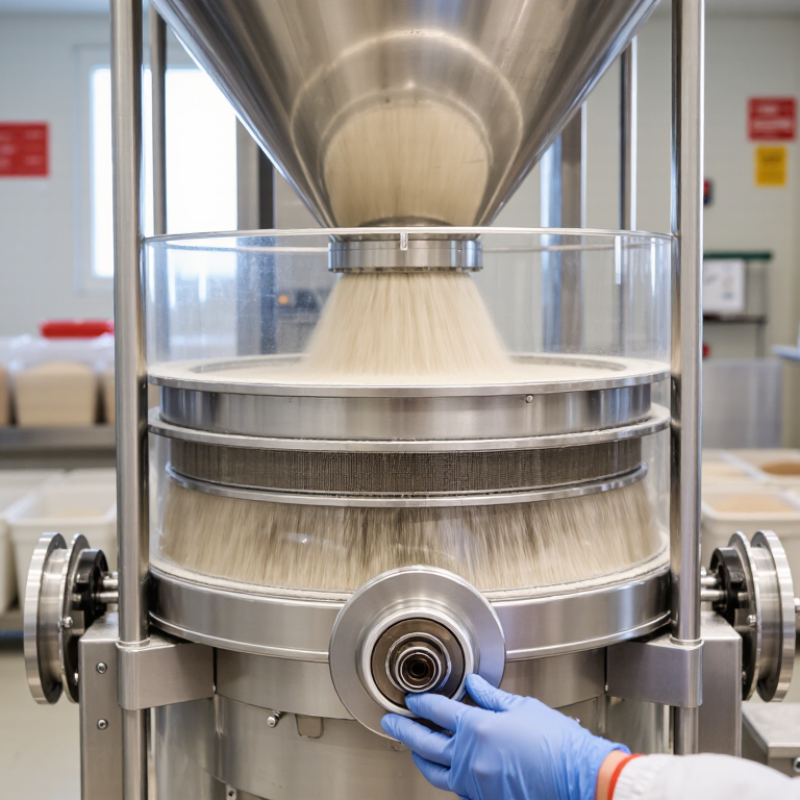
A powder sieve machine separates dry particles by size using a perforated screen or woven mesh. Material lands on the deck, where vibration spreads it into a moving layer. Smaller particles pass through the openings; larger pieces travel toward the discharge outlet. Some machines use several decks to create multiple size fractions in one pass. It sounds simple. It is not automatic. Screen opening, vibration amplitude, feed rate, and moisture all affect separation. Damp powder can cling to the mesh, while excessive feed may cover openings and reduce throughput.

Grand View Research estimated the global food-processing equipment market at USD 52.47 billion in 2023, with projected annual growth of 6.1% from 2024 to 2030. This report covers the wider equipment sector, not sieve machines alone, so it does not prove a particular sieve’s performance.

In practice, operators inspect both the material that passes through and the oversize fraction, then adjust settings to match the required particle-size range. Ask for a screening trial with your own powder and target cut size. Clean mesh matters. Results can still vary.

Which Types of Powder Sieve Machines Are Available in 2026?

In 2026, powder sieve machines come in several designs, each suited to different materials and production needs. Vibrating screen sifters use rapid motion to separate particles by size. Linear models move material along a flat screen, while circular models spread it across a round deck. They work well for many dry powders and can handle multiple mesh sizes.

That matters.

Tumbler sifters use a gentler, rolling motion. They may suit fragile particles or products that need precise separation, though they can occupy more floor space. Centrifugal sifters push powder through a cylindrical screen with rotating paddles. Their compact layout can fit continuous lines, but sticky powders may need closer inspection. Ultrasonic systems add high-frequency vibration to help fine powders pass through small mesh openings. Inline sifters connect directly to a process pipe.

No single design fits every powder.

Tips: Match the machine to particle size, moisture, and required output. Ask for a test using your actual powder, not just a similar sample. Check screen access and cleaning time, too. A finer mesh is not always better; it can reduce throughput or clog. I would still verify performance after installation, since room conditions and powder behavior can differ from a test.

How to Compare Sieve Machines by Capacity, Accuracy, and Design

Choosing the best powder sieve machine in 2026 starts with a realistic capacity estimate. Compare the machine’s rated throughput with your usual batch size, not just peak production. A unit that handles 500 kilograms per hour may perform differently with damp, fine, or irregular powder. Ask for a trial using your own material. Watch how steadily it feeds, and check for buildup around the screen.

Accuracy depends on more than mesh size. Confirm the required particle range, then test samples from several points in the output. Repeat the test; one clean sample proves little. In practical evaluations, small changes in feed rate or vibration can affect separation. Record those settings and compare results across runs. There is no perfect number.

Design matters during daily operation. Look for screen access that allows quick inspection, secure seals that limit dust escape, and surfaces that are easy to clean. Check the footprint, noise level, and how long screen changes take. A compact machine can save floor space but leave little room for maintenance. That trade-off is easy to miss. Ask operators to assess the controls and cleaning routine, too; a technically accurate sieve may still frustrate the people using it.

Which Industries and Materials Use Different Powder Sieve Machines?

Food processors often sieve flour, starch, sugar, and spice powders to remove lumps and control particle size. Vibratory sifters suit many dry, free-flowing ingredients, while enclosed designs can help reduce dust around transfer points. Small details matter. Fine mesh may improve separation, but it can also slow production when the powder is damp or sticky. Operators should check screen openings, feed rate, and cleaning access with the actual material, not just a sample specification.

Pharmaceutical and cosmetic plants may handle fine, sensitive powders that need consistent sizing and careful containment. Ultrasonic systems can reduce screen blinding with very fine powders, though they add equipment and maintenance considerations. In mineral processing, abrasive materials such as ground limestone may call for durable screens and attention to wear. Centrifugal sifters can work well for some cohesive or higher-throughput applications, but suitability depends on product behavior and process layout. There is no universal best machine. A practical trial should measure throughput, oversize removal, and screen wear over time. One overlooked point: powders change with humidity, storage, and handling, so a machine that works on Monday may need adjustment later.

What Is the Best Powder Sieve Machine in 2026?

Choose a sieve by the material, required cut size, and process needs. The chart shows indicative aperture ranges; actual capabilities vary by machine design, screen, and material.

Typical industry and material matches: Vibratory sieves are commonly used for food powders such as flour and sugar, and for chemical powders. Ultrasonic-assisted sieves can help with fine, difficult-to-screen powders such as pharmaceutical ingredients and pigments. Centrifugal sifters are often used for flour, starch, and other free-flowing powders. Tumbler sieves are used for gentle screening of materials including food ingredients, minerals, and some pharmaceutical powders.

Aperture size is not a guaranteed particle-size limit. Product shape, moisture, screen condition, and required throughput affect separation performance.

How to Select the Best Powder Sieve Machine for Your Process in 2026?

What Is the Best Powder Sieve Machine in 2026?

How to Select the Best Powder Sieve Machine for Your Process in 2026?

Choose a sieve machine around your powder and production conditions, not a catalog’s largest capacity figure. Record the target particle range, required throughput, moisture level, and whether the material tends to clump. A fine, dry powder may behave very differently from a slightly damp blend. Test a representative sample when possible. A mesh that looks right on paper can blind quickly during a longer run.

Check how the machine handles feeding, discharge, cleaning, and dust containment. Ask suppliers for test results using your material and the screen size you plan to run. Compare usable output, not just the rated maximum. Also consider changeover time, operator access, and whether the contact surfaces suit your cleaning routine. Small details matter. A difficult screen change can slow a shift, even when separation quality is good. I would treat any test as a starting point, since real production conditions can vary.

Tips: Keep a small sample from each trial. Note the screen, feed rate, and run time, then compare results. If the powder warms, clumps, or leaves residue, investigate before increasing speed. One extra test may save repeated adjustments later.

↑