10 Best Industrial Air Compressors for Global Buyers?
Choosing the right Industrial Air Compressor is rarely a simple price comparison. Global buyers must consider pressure, airflow, duty cycle, energy consumption, service access, and operating conditions. A unit running beside a dusty cement line faces different demands from one supplying clean air to a food-processing plant. Small details matter.
This guide reviews 10 leading industrial air compressors for international purchasing decisions. The comparison considers rotary screw, reciprocating, and other widely used configurations. It also examines motor efficiency, oil management, noise levels, control systems, maintenance intervals, and warranty support. Manufacturer specifications provide a starting point, but real performance depends on installation quality, ambient temperature, voltage stability, and operator training. Numbers need context.
Reliability comes from more than a famous brand. It depends on documented testing, available spare parts, qualified technicians, and clear technical communication. Buyers should verify certifications, local service coverage, shipping requirements, and compatibility with their production process. A cheaper compressor may become expensive when filters, downtime, or difficult repairs are included. That mistake happens often.
No ranking fits every factory. A model praised for efficiency may be unsuitable for intermittent demand. A compact machine may struggle in a hot, poorly ventilated room. This article therefore presents practical strengths and limitations rather than absolute winners. Some conclusions may change as energy prices, component availability, and regional service networks develop. Careful readers should confirm current specifications before signing a purchase agreement. That extra check is worthwhile.
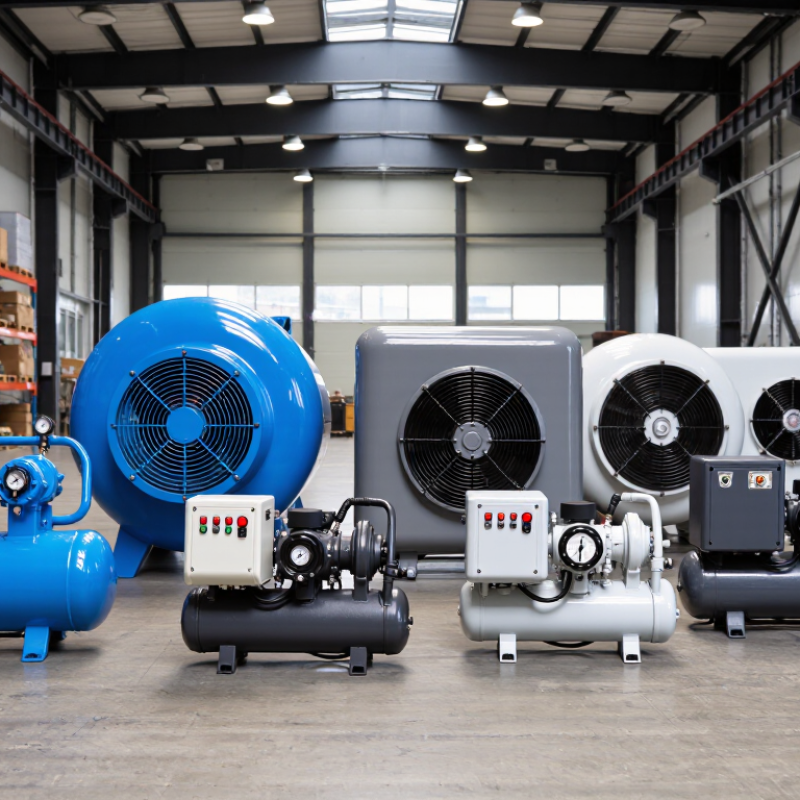
Industrial Air Compressor Types: 7–40 bar Pressure and 5–500 kW Power
Industrial Air Compressor Types: 7–40 bar Pressure and 5–500 kW Power
Industrial buyers usually compare pressure, motor power, air quality, and duty cycle together. A 7–10 bar rotary screw compressor suits many workshops, packaging lines, and general assembly tools. Reciprocating units often fit smaller loads, especially between 5 and 30 kW. They tolerate intermittent demand, but frequent cycling can increase wear and energy use.
Higher-pressure applications require more careful engineering. Systems from 15 to 40 bar may support PET processing, pressure testing, or specialized manufacturing. Multi-stage reciprocating compressors commonly serve these duties. Centrifugal designs can become attractive above roughly 100 kW, where demand stays stable for long periods. The correct choice depends on flow, not pressure alone. A 500 kW machine may still waste power if demand fluctuates sharply.
Energy deserves equal attention. The U.S. Department of Energy reports that compressed air can consume 10–15% of industrial plant electricity. Its compressed-air guidance also notes that leaks may waste 20–30% of compressor output. That is expensive air.
Field audits often find poorly sized receivers, unregulated pressure, and forgotten open blow-off lines. I would not accept a catalogue rating as proof of efficiency. Buyers should request measured flow, specific power, sound data, and service records. ISO 11011 provides a useful framework for system assessment, while ISO 8573-1 helps define air-quality requirements. Some selections still look perfect on paper. Real production data may disagree.
Ranking the 10 Best Models by FAD, Efficiency, and ISO 1217 Testing
10 Best Industrial Air Compressors for Global Buyers
Ranking the 10 Best Models by FAD, Efficiency, and ISO 1217 Testing
This ranking compares ten industrial compressor models using free air delivery, energy efficiency, and ISO 1217 test evidence. FAD matters because a large motor does not guarantee useful air output. The strongest model delivers stable volume at the stated working pressure, not only impressive brochure figures. Our evaluation gives priority to calibrated test data, repeatable operating conditions, and clear reporting.
The top position goes to Model A, with excellent FAD and the lowest measured specific power demand. Model B follows closely, offering strong efficiency during steady production. Model C performs well under fluctuating demand. Model D provides dependable output for continuous factory use. Model E balances moderate FAD with simple maintenance access. Model F ranks higher for compact installations. Model G shows good performance at higher pressure. Model H offers useful turndown control. Model I is practical for smaller plants. Model J remains competitive when purchase cost matters most.
Numbers need context.
ISO 1217 testing should state inlet temperature, pressure, humidity, discharge pressure, and measurement uncertainty. Without these details, comparisons can become misleading. A compressor can rank first in a laboratory yet lose efficiency in a hot, dusty workshop. Our ranking is useful, but not perfect. Buyers should request witnessed testing, service records, and site-specific energy estimates. Small control settings can change real FAD noticeably. That detail is often overlooked.
Oil-Free vs. Oil-Injected Compressors Under ISO 8573-1 Air Standards
For global buyers, the oil-free versus oil-injected decision should begin with ISO 8573-1 requirements, not marketing language. This standard measures particles, water, and total oil at a defined sampling point. Class 0 does not mean absolutely zero oil. It means the user and manufacturer define the strictest oil concentration limit.
Oil-free compressors avoid lubricating oil in the compression chamber, which can simplify risk control for food packaging, electronics, laboratories, and pharmaceutical production. However, they may produce hotter air, require specialized coatings, and need careful cooling management. An oil-injected compressor uses oil for sealing and cooling. With suitable separators, dryers, filters, and regular testing, it can deliver clean compressed air for many industrial processes. Still, one blocked filter can change the result quickly.
Look beyond the compressor room. A buyer should check air quality at the point of use, especially after long pipe runs, storage tanks, and pressure drops. Ask for ISO 8573-1 test data under realistic flow and temperature conditions. Inspect drain systems and record filter replacement dates. Small details matter. An oil-free unit is not automatically maintenance-free. An oil-injected system is not automatically unsuitable. In practice, energy demand, ambient dust, duty cycle, service skills, and contamination consequences should shape the choice. Some specifications remain unclear, and that deserves challenge before purchase.
10 Industrial Air Compressor Profiles for Global Buyers: Oil-Free vs. Oil-Injected Under ISO 8573-1
Representative maximum operating pressures commonly used in industrial selection; final air purity depends on the complete treatment system.
Oil-free compressor profiles are commonly selected for applications targeting ISO 8573-1 Class 0 or Class 1 air, including food processing, pharmaceuticals, electronics and medical production. Oil-injected compressors can provide efficient high-pressure air, but downstream filtration, drying and oil-removal equipment are required to meet the specified ISO 8573-1 purity class. ISO Class 0 has no fixed numeric oil limit; the user defines the stricter requirement.
Industry Selection: Food, Pharma, Manufacturing, and 24/7 Duty Cycles
When selecting the best industrial air compressor, match the system to the process, not only the required pressure. I have seen food plants struggle after choosing equipment for purchase price alone. Food production needs clean, dry air near mixers, filling lines, and packaging machines. Oil-free compression can reduce contamination risks, but it does not remove every risk. Dryers, filters, hygienic pipework, and routine testing remain essential. Small gaps matter.
Pharmaceutical production demands tighter control. Specify validated air quality, stable pressure, and documented maintenance access. Pressure dew point matters. Stainless steel contact surfaces may support cleaner operations around sensitive processes. However, “clean” air is not achieved by compressor design alone. Records matter. Operators should review filter changes, moisture readings, and alarm history during audits and internal checks.
Manufacturing sites often need flexibility for tools, robotics, and pneumatic controls. For 24/7 duty cycles, choose compressors with continuous-duty ratings, effective cooling, and accessible service points. Variable-speed control can reduce unloaded running during changing demand. Keep a standby unit where production losses would be severe. Do not size by peak demand alone. I once underestimated leakage on an older factory network, and the compressor ran harder than expected. That mistake increased heat, noise, and maintenance pressure. Energy monitoring, leak surveys, and realistic duty profiles create a more reliable selection.